
Your Custom Text Here

THE POWER OF PAPER
A recent post focused on the personal value of a wedding, event or family album. Now I’m excited to write about one of my favorite photo subjects, and one that is often overlooked: PAPER.

iolabs print on Rag paper with 8-ply Rag mat
A recent post focused on the personal value of a wedding, event or family album. Now I’m excited to write about one of my favorite photo subjects, and one that is often overlooked: PAPER.
Although I still hand-process my black & white film, I stopped manually printing my photos four years ago. It was SO hard for me to completely make this shift. First of all, I love printing: I started when I was 14 years old and never stopped. And to be honest, I’m just plain stubborn!
In addition to printing all of my black & white work for over 20 years, I also printed some of my color photography and enjoyed some alternative processes as well. One of the most fascinating things about the printed photograph is that the same image can have such a different look, feel and vibe depending on the paper and process it’s made from. Every so often, I’d get into “Mad-Scientist mode” and experiment in my darkroom by taking one single negative and printing it onto one type of paper, processing it 3 or 4 different ways; and then repeating this with ten or so different papers (all using that one image). I had a way of cutting the edges of the paper to use as “code” to decipher the paper/chemistry combo to later compare them side-by-side. At the end of the day, my darkroom would be literally COVERED with over 50 variances of the exact same photograph. My assistants would enter the darkroom to find me with a big smile on my face! :-D
I have now trusted the printing process to Printmakers in Pawtucket, RI and iolabs in East Providence, RI. They are different types of printers for different types of projects. Printmakers still processes my color film and they maintain excellent print quality. They add, "We at Printmakers are excited to witness the shift in the creative world as the process has swiftly become more digital over the years. As a result, we’ve become nostalgic towards those original analog traditions. There is something irreplaceable about the touch and feel of the printed page. The tangible quality of paper is the reason why it has become a selectively used material, now reserved for specific purposes. In short, when someone chooses paper, they are commemorating something worthy of note; paper is as important to the business as the work itself."

Printmakers print on Pearl Surface paper, hand-mounted onto Rag album page
With iolabs, there are many photographic papers and surfaces to choose from and all of them are of superb quality. Over time, I’ve come to rely on a couple of “Go-To” papers for the majority of my work: I know what to expect from these particular papers and I feel they represent my work really well. But there are times when a photo calls for something different: I recently had a large piece made for a client that looks fantastic as a super gloss finish. Although I rarely print on glossy paper, I couldn’t imagine this one done any other way - it looks fantastic. And another photo may look better on completely flat matte finish. It really depends on what we’re going for, and these are collaborative efforts between my client, my printer and myself. Bonus: I still get to be a mini-mad-scientist while trying all of these papers (you can take the girl out of the darkroom but you can't take the darkroom out of the girl)!
iolabs adds, “iolabs is devoted to offering a wide range of papers for any artistic medium. Each paper is hand selected and tested in our studio to ensure that we are providing our clients a paper that we trust to perform consistently and perfectly. We are proud to offer a handful of photographic papers that print images with clarity and sharpness, in conjunction with archival qualities to help ensure that the image outlasts us all. The simple act of choosing a paper provides the opportunity to select a material which adds a greater level of representation to the image. Ultimately, a paper choice plays an important role in representing your message as a photographer.“

iolabs print collage on Rag album page
I am definitely a believer that it’s the ENTIRE process that will dictate the strength and impact of the final outcome. I have been truly fortunate to work with both Printmakers and iolabs to ensure this for my photography.
Email me anytime for topic suggestions and feel free to comment, ask questions and share. Thanks for reading!
Peace, Love & Happy Planning,
Dana Siles


THE PHOTO ALBUM: TO DO OR NOT TO DO? 5 FACTORS
Times have changed over the 18 years I have been a wedding and event photographer. For a long time, the majority of my clients would expect an album – and often one for the parents and/or family members. Although the majority of my clients still feel the same, it’s no longer a given. So what’s changed? Based on my experience, I’d like to share what I believe are among the factors for this fairly recent shift and also to discuss when and why I believe wedding and event albums are important.
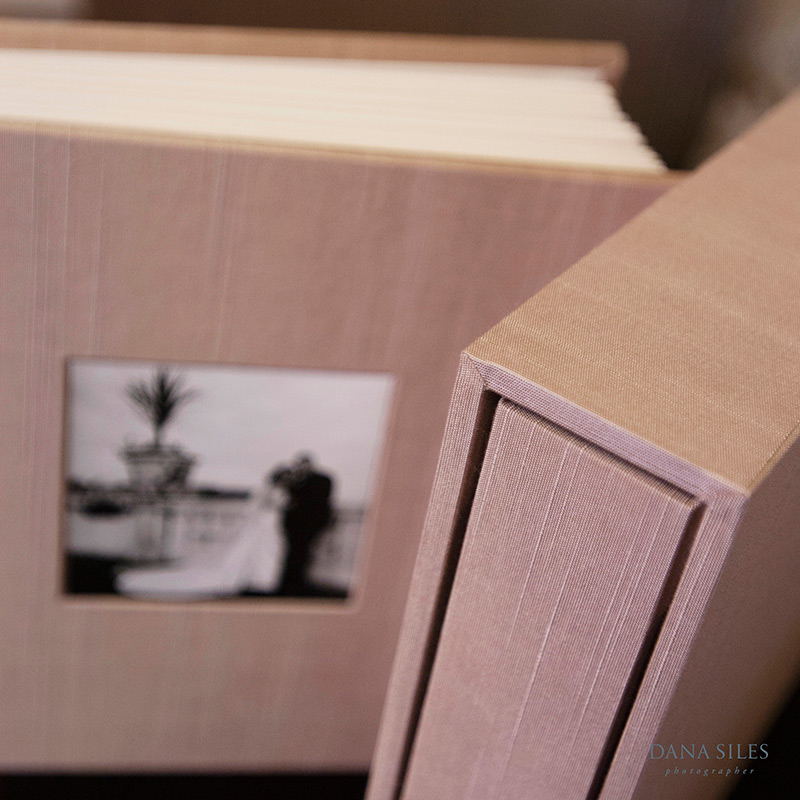
Times have changed over the 18 years I have been a wedding and event photographer. For a long time, the majority of my clients would expect an album – and often one for the parents and/or family members. Although the majority of my clients still feel the same, it’s no longer a given. So what’s changed? Based on my experience, I’d like to share what I believe are among the factors for this fairly recent shift and also to discuss when and why I believe wedding and event albums are important.
1. First and foremost, the economy is a factor for the average household - and let’s face it, for many, a wedding or event album is not a priority, it’s an indulgence. That said, I do know that many couples and families have regretted not investing in a quality photographer and/or a quality album. Go to any wedding/event forum online and you will read numerous examples of regretful purchases. I believe couples and families need to ask themselves: what will mean the most to me and my children 1, 10, 30 years from now? I’ve worked with limited budgets under 20K, nearly unlimited budgets over 500K and everywhere in-between – literally - my clients truly span the entire socio-economic scale. But what they all have in common is that they truly value pictures, and they all structured their wedding or event budget accordingly.
2. The digital revolution has produced many photographers. This is a pretty loaded subject in itself, which I may dedicate my thoughts to (and those of fellow photographers) in a future post. Regarding the question of a wedding or event album, although some of the newer photographers are fantastic and I enjoy and respect their work, unfortunately, the fact is that many do lack professional shooting and album building experience. In many cases, the couple is left with unedited files of a full day of coverage. I believe you would be much better served to hire a quality photographer for fewer hours, capturing the most important aspects of your wedding day with quality expertise throughout the entire process. Why? Because a digital file is to be treated as a start, not a finish: think of your digital file as a negative, which needs to be processed to make a quality print. Furthermore, narrowing down from 1000 photos to 100 select photos to really tell the story is a true craft in itself. If you consider yourself a picture person and/or want your future generations to have an album as a family heirloom, then by all means consider investing in an experienced, quality photographer and including your photography as one of the wedding or event priorities.
3. The digital medium has made viewing photos much easier and more cost efficient for many of us. Back in the (dare I say) not-yet-old-days, negative film had to be processed and printed to see the photos. Some of us, myself included, would then edit the photos and put them into a photo album (or commission a professional to do so for a special event or wedding). Now, a simple click of a button and - there they are. This is great. However, by definition, photos are often unedited and become trapped in the computer or on Social Media. Now, I certainly believe platforms like Facebook have their place. I like Facebook and totally use it both personally and professionally. That said, every year, I make a family album for everyone in my family, highlighting our family’s special events. Yep, an actual album – paper pages included! I don’t want my niece and two nephews to grow up solely relying on a monitor to see their family pictures. I love knowing that, every once in awhile, they cuddle up on the couch together to look at their photos; and I smile at the thought of the album spread out between two or three laps, flipping the pages together and enjoying the quality time together - making memories while remembering them. That is how I want my family to enjoy their memories and I feel the same about this for my wedding, event and family clients.
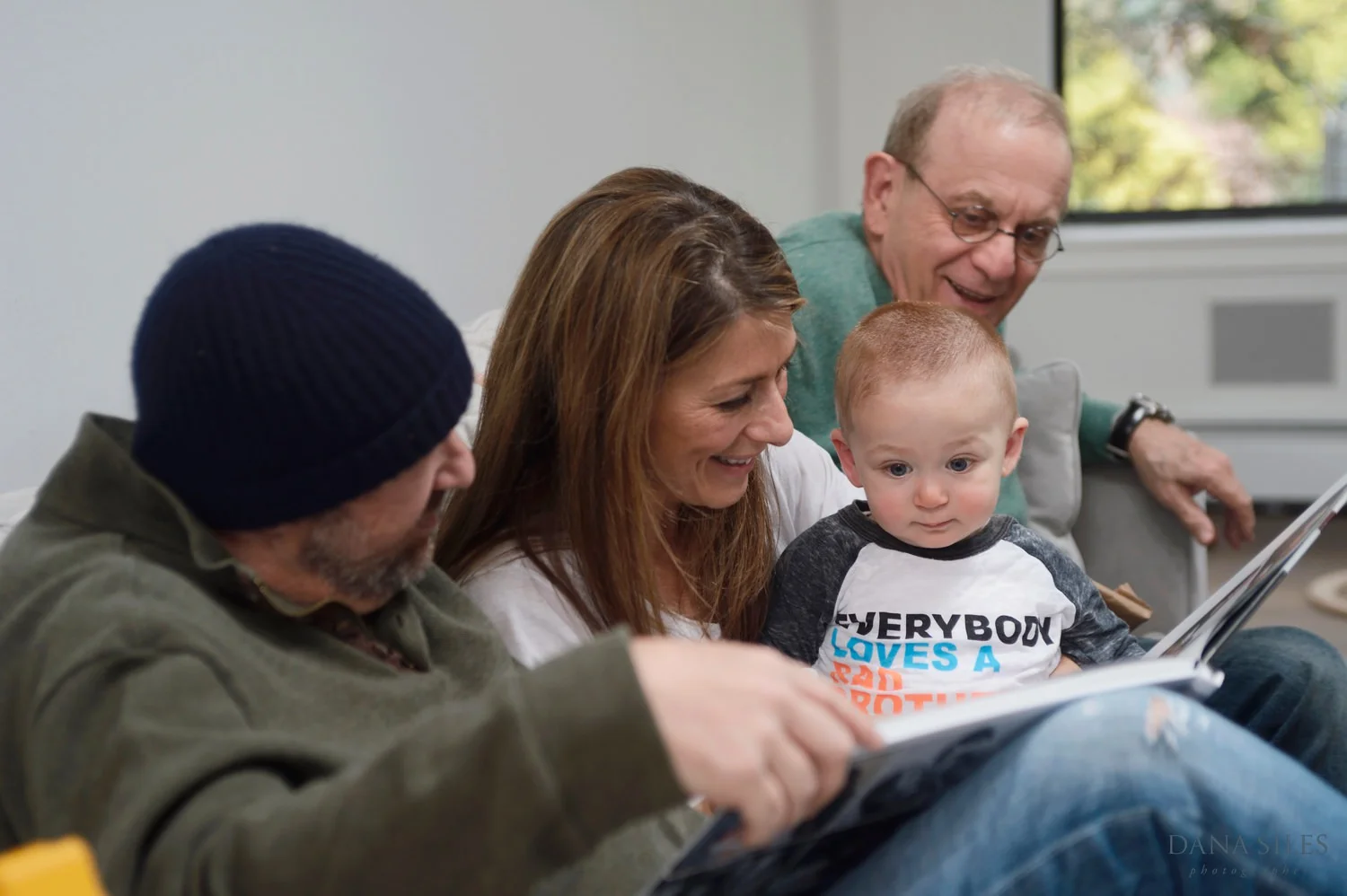
My family enjoying their annual photo album
4. Are you a Picture Person? Do you feel that your own family pictures are valuable to you, whether they be 2 years old or 20+ years old? If you are someone who loves pictures, then having a well-made album is worth the cost and time. But if an album just feels like a formality to you, then perhaps a different approach is worth investigating.
5. Whether or not you choose to start a family may influence your decision about investing in a wedding album. Does it mean a lot to you to have this family heirloom to pass down to your children? It’s a personal question, but one that I do believe is important to answer for yourself, and for any future generation(s).
To summarize, Terry Huang Jr., Customer Service Manager at Renaissance Albums (one of my album binders) adds, “From a photographer's perspective, it's vital to preserve your work and ensure that it's displayed on the best "canvas" possible. Offering quality albums does this, while also providing your clients with the best end-product available. As a potential album recipient, they should realize that the albums offered by their professional photographer are not the same as the ones available to the general public - not even close actually. They are professional-grade and only sold to photographers, and therefore the quality and craftsmanship is on an entirely different level from the "photo books" they can purchase online directly on their own. Additionally, sharing files on social media or on a screen is something we all do and is very convenient, but it pales in comparison to looking through a beautifully-printed album that has been thoughtfully edited, designed, and handcrafted by experts. There's just something special about having a tangible album containing your best memories to share with family & friends at gatherings, opposed to the simple "click-and-scroll" viewing that we are all so used to, but doesn't truly capture your special day or do it any justice.”
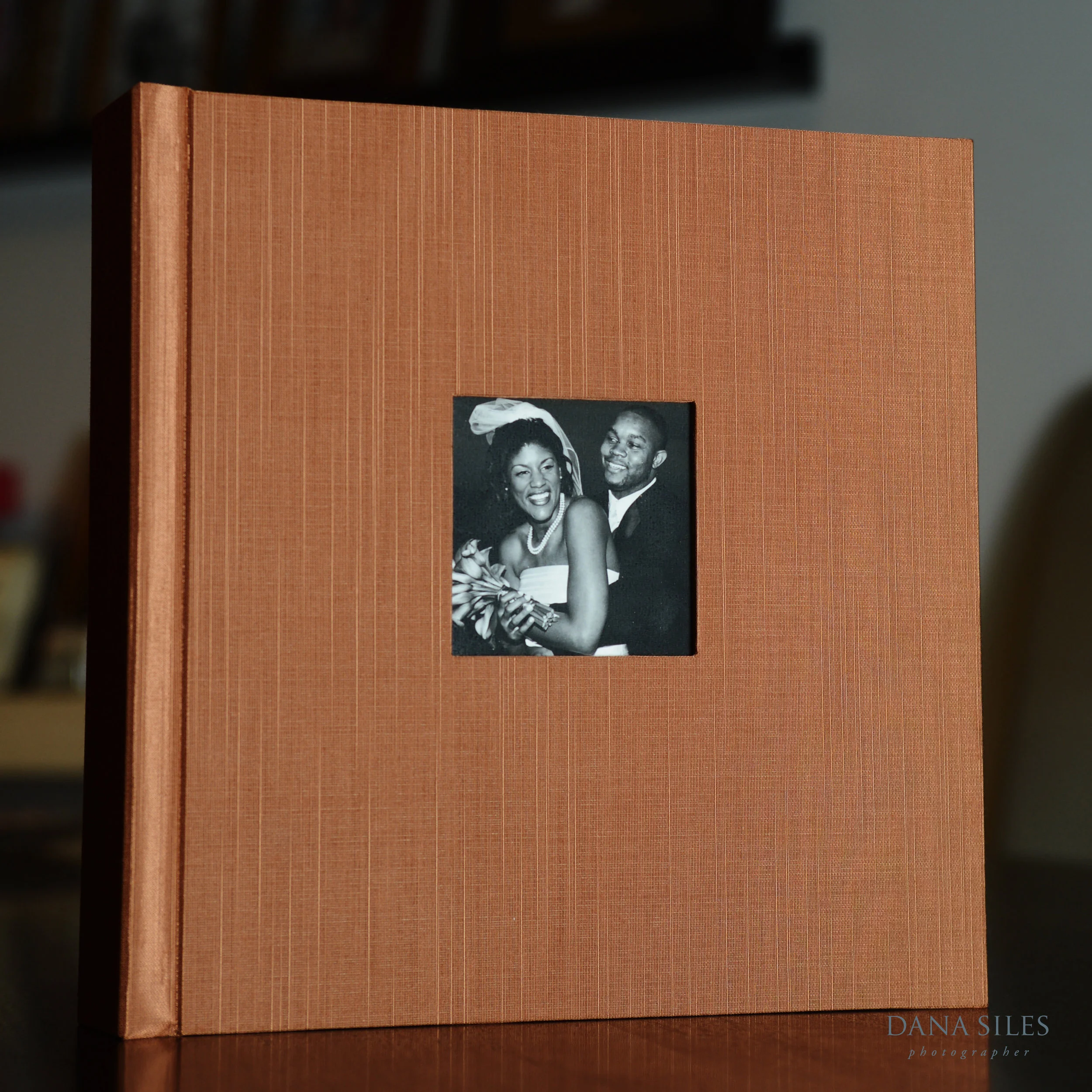
Renaissance Album: Renee & Ernest's wedding album
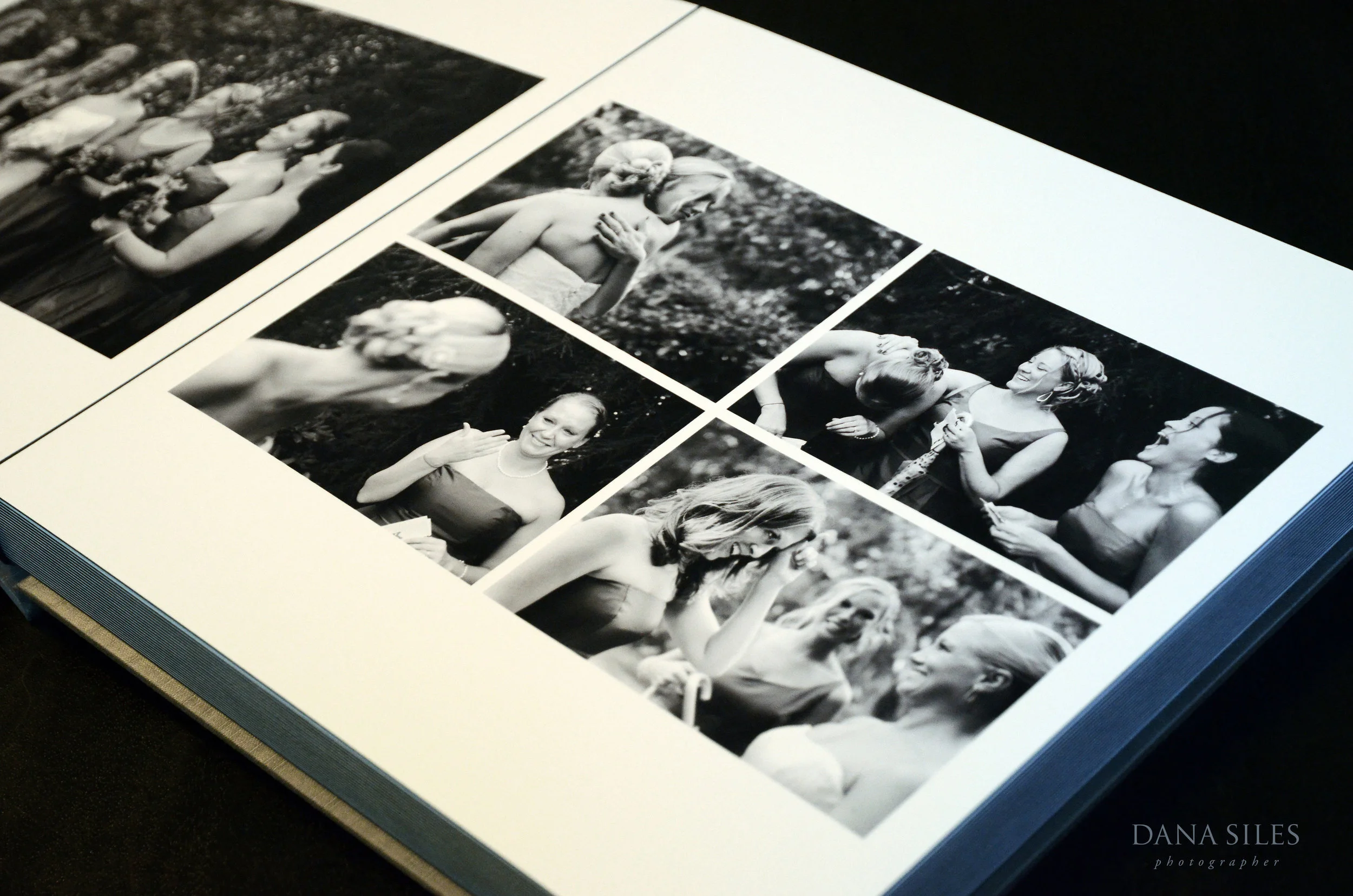
Renaissance Album: Julia & John's wedding album
There is no One Size Fits All to wedding, event and family photography - or to the creative process. My biggest suggestion for anyone hiring a photographer is to ask the right questions based on your personal needs so that you feel confident in your choice.
Email me anytime for topic suggestions and feel free to comment, ask questions and share. Thanks for reading!
Peace, Love & Happy Planning,
Dana Siles

CHOOSING THE RIGHT VENDORS
PART 2 | Completing Your Photography Search: Brief Technical Advice for the Non tech/creative
If you don't know a lot about photography, how do you form the right questions? Here I will attempt to make some sense of the basics and help guide you in your next steps towards choosing the right wedding or event photographer.
PART 2 | Completing Your Photography Search:
Brief Technical & Creative Advice for the Non-tech/creative

Candid moment during Anne's portrait with her parents. The Chanler at Cliffwalk, Newport, RI. Medium Format Film.
I suggest reading Part 1 | Starting Your Photography Search: Deciphering Your Needs and How to View Websites to preface Part 2.
For any important purchase, we need to ask the right questions in order to make the best personal decisions. Part I concluded with: make notes and questions and select 3-5 photographers you’d like to learn more about. But if you don't know a lot about photography already, how do you form the right questions? Here I will attempt to make some sense of the basics and help guide you in your next steps towards choosing the right wedding or event photographer for you.
1. After you’ve emailed and/or spoken with a few photographers, meet with your top 2-3 choices: Purchasing products and services via internet/phone is standard these days, but wedding and event photography is not something you can “return” if you later learn that your photographer or their product(s) did not meet your expectations. View complete sample photo albums, loose prints, wall and table display options and meet and talk with us, in person. If this is not an option, Facetime or Skype will suffice, and most can ship you an album to view. Photos and albums can look incredibly different on a monitor, so it’s important to truly see the quality of the prints, display and album options, etc. Do the pages feel sturdy or flimsy? Is the cover made with thick, quality board or thin board that can easily dent over time? How is the quality of the photography itself: is the color and density true or do the whites look blown out or do the blacks often appear muddy, lacking detail?
2. It’s important to know for sure that your photographer brings backup gear to your wedding or event: extra cameras, lenses, batteries, memory cards, etc. This is very basic but unfortunately not a given: gear is expensive, so less reputable and/or less experienced photographers may not be thoroughly equipped. Years ago, one of my cameras failed just minutes before the ceremony. I grabbed my spare and was good to go - no worries. Any responsible pro will do the same.
3. Quality pro digital cameras have two card readers in the camera: so as we shoot, we are backing up our files in real time. This is extremely important. Cards can fail, and this is beyond our control - so if your photographer is backing up while shooting, it could potentially make the difference between having or not having photos at the end of the day. Furthermore, make sure the photographer you choose will backup your files to external drive(s) and/or Cloud service during or afterwards. Most of us do both, providing a total of around FIVE copies of each original file within hours of your wedding or event (two original cards from cameras, main computer drive, external drive(s) and/or Cloud).
4. Professional wedding and event photographers who strive for utmost photo quality and file size shoot RAW files (and/or film). In a nutshell: RAW is layered, the equivalent of a negative, meaning it includes the maximum amount of file information possible; JPG is flattened, (or let’s say “cooked,”) a final version to print from after processing the RAW file. Some photographers may argue that the visible difference between shooting in JPG and RAW is so slim that it’s not necessary to shoot RAW. Some may believe this to be true and although I strongly disagree, that is their opinion. Keep in mind, though, that there are photographers who may say this simply to increase their profit margin because it’s more time-consuming to process an unprocessed RAW file than it is to work with a processed JPG file. Furthermore, it takes a “meaner” machine to process RAW: hard drive space, speed and quality hardware/software is costly. We photographers who work in RAW are using (and backing up) TERABYTES of space via internal, external and cloud storage.
5. Pricing Structure: Be careful not to define a photographer's pricing on coverage alone: ask those you are interviewing to provide a total estimate for you, including albums, loose prints, your digital files if applicable, etc. Make sure you understand and agree with any additional fees that may be applied to ensure no unwelcome surprises: S/H, sales tax, travel fees, processing fees, additional coverage, second shooter if applicable, etc. and be attentive to the bullet points or fine print for "all inclusive" packages.
Extras:
6: Arrival: If we’re not early, we are late. Reputable photographers will arrive no later than 20 minutes prior to scheduled time (ideally 30-60 minutes).
7. Attire: Ask what the photographer (and our assistant(s), if applicable) will wear to your ceremony or event. We should blend in, no sneakers, not too tight/low/high, no loud shoes (you don’t want to hear flip-flip or clunk-clunk during the ceremony). Most of us have different outfits for different types of jobs, like beach wedding vs. black tie event. I learned this the hard way: by wearing all black to a beach wedding! Not only did I stick out like a sore thumb, I got a mean sunburn!
8. Availability: Make sure that you are guaranteed to get the photographer you have interviewed and not an associate. If you are hiring an associate, interview them directly. In addition, what is the photographer’s policy if he/she is unable to photograph your wedding or event? A responsible planner can rely on Plan B in case of emergency.
9. Lawsuits: Although I’ve personally never experienced a lawsuit, I do have reputable photographer friends who have been sued one or two times over 20+ years in business. Maybe their fault, maybe bad luck - I wouldn’t necessarily hold this against them. But if a photographer says they’ve been sued 3, 4, 5 times, I’d consider that a red flag.
10: Turn-around: It’s important that you understand the turn-around time for your wedding and event photography, and that this information is clearly stated in the photographer’s brochure and/or agreement. If there are unforeseen issues with turn-around on the photographer's end, which can happen, they should simply communicate this with you and keep you updated.
It certainly takes attention to detail, patience and research to make the right decisions for your photography needs and budget. But enjoy the process, don’t get hung up on the small stuff and have faith that you will make the right choices. Learn more by reading Frequently Asked Questions. Email me anytime for topic suggestions and feel free to comment, ask questions and share. Thanks for reading!
Peace, Love & Happy Planning,
Dana Siles
